Thursday, January 4, 2007

Natural 'Hoods

I wrote before about green neighborhoods, and today TreeHugger has a post about an article in Natural Home Magazine that rates America's top 10 Eco-Neighborhoods. No. 1 is the West Asheville Neighborhood in Asheville NC, followed by the South Congress Neighborhood in Austin TX. A newbie in the eco-world is Indiana's own Fall Creek Place in Indianapolis, ranked No. 7. I'll have to take a drive through next time I go down to wrangle with the regulators.

COMMENT !

I'm happy to see that I'm getting a few hits from across the US and around the world. As you can see, right now I'm just writing about whatever smacks me in the face that day. This site could be much more useful to all of you if I knew what you were curious about, or knew what you were having trouble with.

I like reading and researching about how people can be more green, and I feel that by sharing whatever knowledge I can gather, we will all be more able to make better decisions that help protect the environment.

So add a comment, ask a question, bitch, whatever ... I want to hear it.

LED Again

Ever wonder why you keep hearing, over and over and over again, that you should change your lightbulbs to flourescents or LEDs? Yes, I've mentioned it a few times already too. Well, it's because it's the easiest (how many average Americans does it take to change a lightbulb?), it's cheap, and it really makes a difference (energy=environment). In other words, it's where every aspiring treehugger should start ... Wait, no ... it's what anybody with common sense should do.


Thanks to my Brother-in-Law John for sending this email:

"And LED is truly the way to go if you can get the color temperature that you want. I have two fixtures that are designed for accent lighting right now that are fun ...http://www.chauvetlighting.com/fixtures/colorsplashjr_fix.shtml, but don't really do justice on the pure white or yellow tints since they use color mixing tech. These guys have a few heavy output jobs, but again, the prices...http://www.enluxled.com."
I couldn't get the Chauvet link to work this morning, but Enlux has a good site that discusses their green-ness very well. Enlux also has a photo gallery that really shows you what LEDs can do these days.

Wednesday, January 3, 2007

Organic Cotton

I don't believe one can talk about organic cotton without mentioning Patagonia. While they could never have made the conversion without the smaller companies that started the trend and the existing organic farmers, Patagonia kicked the trend into a higher gear. Since then, organic cotton has sprouted up almost everywhere you turn.

I got a very nice organic cotton blanket for my daughter from WalMart, where there is also a decent selection of organic cotton baby clothes.

One of my favorite brands, Speesees, uses fair-trade organic cotton for some very clever kids clothes.

Gaiam, another fav green shopping site, has organic cotton clothes among everything else green. My wife is wearing some organic cotton pants from there right now.

Organic Cotton yarn, fabric, batting, etc. is also available online for the do-it-yourselfers at places like earth friendly yarns and sewshoppe.

Tuesday, January 2, 2007

Kill 2 Evils with 1 Bike

My wife just called, which forced me over to my cellphonetalking position at my office window. I looked out at the long wintery shadow of the foundry on the nonwintery green grass. We've been talking a lot about the weather 'round here lately - especially since we spent 4 days up at Houghton Lake (Northern Lower Michigan) at my parents' house and there was no snow (it wasn't even cold enough to make snow - we tried!). Tip Up Town is scheduled for a few weeks from now and the lake isn't frozen. I guess the west and plains got the snow normally allocated for all of us this season.

We're going to try to get by with just 1 vehicle starting Friday - a nice treehuggerish thing to do. I actually don't think it will reduce our footprint any since we'll probably do the same or maybe just slightly less driving. We have talked a lot about getting me a good road bike so I can pedal the 18 miles to work. I figure it will take about an hour once I'm in shape for it. Well, the bike isn't in the budget for the near term, but the weather got me thinking (uh oh).

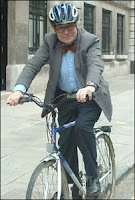
As you might have guessed, treehuggers are rightfully BIG on biking. Not only does our environment need a rest, but most of us rest way too much. Why don't more of us bike to work? I'm not kidding. I am confident that at least 30 people at my office live 5 or fewer miles from work, where there are showers and changing areas. So, if they could get to work in 20 minutes, take a quick shower, and have their workout done for the day, why not kill two evils with one bike?

Monday, January 1, 2007

The Evolution of Eco Books

Call this an addendum to the last post. While reading over those reviewed by BookPage, I couldn't help but think of a few on my shelf. As I pulled the dust bunnies off of them just now, I realized that the three books I'm about to mention pretty well cover the entire evolution of the environmental movement, and I think aptly demonstrate the knowledge level of the time they were written.

Few will deny that Silent Spring by Rachel Carson all but formally began the mass environmental movement. Writing in 1962, Carson noted that she could no longer hear the birds chirping as she once did, or how her parents or grandparents often described. She writes mainly about pesticides and their reckless use, but also about other social and political factors and the parts they play in the destruction of our ecosystems. This was, and remains to be, an accurate and well written "state of the environment." Even though it was published 45 years ago, I still recommend it.

Before An Inconvenient Truth, Al Gore wrote Earth in the Balance; Ecology and the Human Spirit. I read this back in college, and even then thought "Whoa, easy there killer!" Gore didn't have very good data and often spewed diarrhea-like from his typewriter in 1992. I remember many people referring to this book and asking, "Do you want THAT guy to be our President??" when he ran against Bush. My answer was no. I don't recommend reading Earth in the Balance unless you like science fiction, but I think it nicely captured the knowledge level of 1992: we knew there were problems, but we were all over the board about what we should do about it.

And lastly, a super intriguing book called Cradle to Cradle; Remaking the Way We Make Things by William McDonough & Michael Braungart (1992). Even after 4 years (or 5 today - Happy New Year), this book is still rattling heads. You may have heard the phrase Cradle to Grave, but this book challenges even the old mantra of the 3Rs: Reduce, Reuse, Recycle. They consider traditional recycling "downcycling" and offer the alternative of "upcycling" - where a product actually becomes higher quality with use, or at least not lower quality. It is quite obvious that most of the things we recycle are only recycled once, and are no longer recycleable: the free pencils made out of recycled pop bottles that one can find anywhere, for example. The first chapter is named "This book is not a tree". Let me quote one paragraph for your thought-provocation. "This book is not a tree. It is printed on synthetic "paper" and bound into a book format developed by innovative book packager Charles Melcher of Melcher Media. Unlike the paper with which we are familiar, it does not use any wood pulp or cotton fiber but is made from plastic resins and inorganic fillers. This material is not only waterproof, extremely durable, and recycleable by conventional means; it is also a prototype for the book as a 'technical nutrient,' that is, as a product that can be broken down and circulated infinitely in industrial cycles - made and remade as "paper" or other products." I just got this one for Christmas so can't give my full review yet, but all the other treehuggers around are huge fans.

Save the Planet One Book Report at a Time

While checking out at the library a while ago, a high school girl next to me laid her books on the counter and the clerk immediately said, "Someones doing a paper for school." After smirking about the clerk's nosiness, I looked at the girl's collection and they were all about climate change. She didn't appear pleased about the assignment, but maybe she was just smirking at the clerk's nosiness too.

I remember doing my first environmental reports and it was really hard to find any good resources at most libraries. Now, of course, every ex-vice president and his brother have written books on the subject. Many of these books are specialized so you can get decent info on everything from ice caps to the deep see or the boreal forest.

Then last week I picked up the latest BookPage, which can be found at most libraries, and the cover story is about environmental books.

I've not read the five books they feature, but I'll list them here with a quick summary and you can check them out.

Worldchanging: A User's Guide for the 21st Century is one I've heard a lot about. This is a true treehugger book and will present a new way to do everything you do. If you want to change and need ideas, read this.

Hell and High Water: Global Warming-The Solution and the Politics-and What we Should Do has too long a title, but sounds like it might hit the spot on how environmental protection is not about environmental protection - it's more about politics. The review says that the book offers many problems and not many solutions.

The Rough Guide to Shopping with a Conscience sounds very cool to me, as one who wishes to put his money where his mouth is. The review points out that this book is very credible and current, hence useful.

365 Ways to Change the World: How to Make a Difference One Day at a Time is one of those books that offers you some idea every day, from donating money to simply meditating about some topic.

The Business of Changing the World sounds like it has more to do with philanthropy than granola. It's written by the head of Timberland (shoes) and focuses on how companies can make a difference through volunteering and giving. While this isn't directly environmental, it's easy to choose an environmental project or program when considering philanthropy.